

 |
| Vanley Burke. Velrose, Cannon Hill Park. 1972 (c.). |

The Vanley
Burke Retrospective exhibition titled, By
the rivers of Birminam, opened at the FADA Gallery on Thursday evening.
The Executive Dean Federico Freschi welcomed everyone, especially Vanley Burke, the photographer and the curator Lynda Morris. The opening was well attended by staff, students and the local community; enjoying great food, appropriate Rastafarian music, and warming fires – an evening enjoyed by all. Tracy Murinik, research and projects Director in VIAD gave the opening address.
The Executive Dean Federico Freschi welcomed everyone, especially Vanley Burke, the photographer and the curator Lynda Morris. The opening was well attended by staff, students and the local community; enjoying great food, appropriate Rastafarian music, and warming fires – an evening enjoyed by all. Tracy Murinik, research and projects Director in VIAD gave the opening address.
 |
| Vanley Burke, African Liberation Day, Handsworth park. The crowd listens to speakers from Africa, America and the Caribbean bringing news and information of the Black Diaspora. 1977. |


By the
Rivers of Birminam an exhibition by Vanley Burke and accompanying Public
Programme.
 |
| Themba Mantshiyo reading Vanley Burke's retrospective exhibition statement, By the rivers of Birninam. |
The Exhibition
FADA
Gallery.
Bunting Road Campus, corner Annet and Bunting road (Opposite Gasworks)
Gallery
hours: Mondays to Fridays 09:00 – 16:00.
 |
| Wilhemina viewing the works. |
 |
| Farieda, Lesley and Thandi. |

First Panel
Discussion. Today Sunday 27 July 2014, 15h00 -17h00. FADA Gallery.
Positions of Enunciation; Presenting, Reading and Receiving by the Rivers of Birninam.
‘We all write and speak from a particular place and time, from history and a culture which is specific, What we say is always 'in context‘, positioned (Hall 1993:23)
Chair:
Nontobeko Ntombela
Presenters:
Vanley Burke, Leora Farber, Shona Hunter, Lynda Morris and Tracey Murinik.
PS. The rest of the program is listed at the bottom of this post entry.
For further information on the exhibition and Public Programme schedule, please contact Reshma Chhiba: reshmac@uj.ac.za (011) 559-1393.
For further information on the exhibition and Public Programme schedule, please contact Reshma Chhiba: reshmac@uj.ac.za (011) 559-1393.


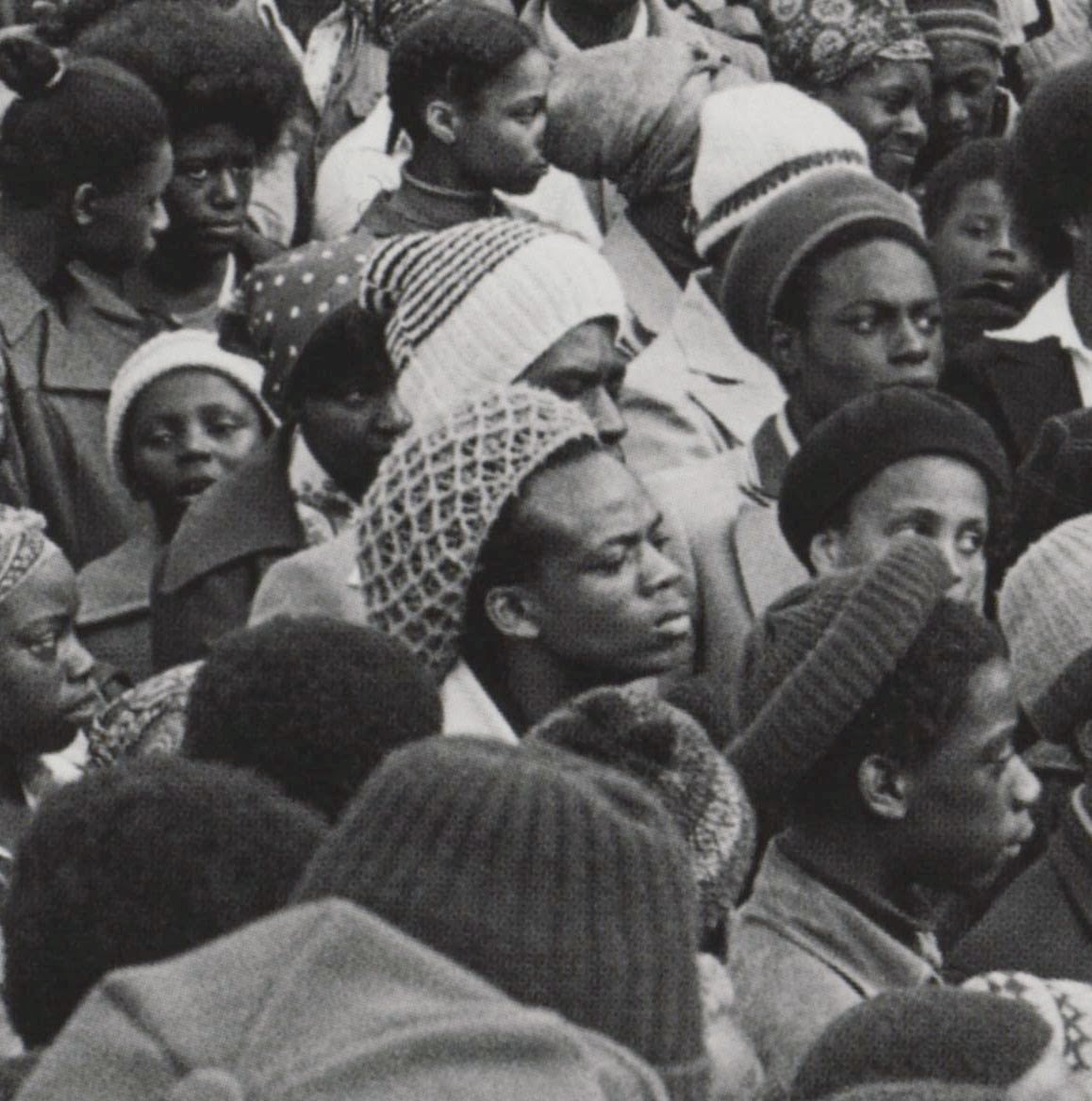 |
| Vanley Burke, Africa Liberation Day, Handsworth Park (Detail) 1977. |
Exhibition Opening Address
by Tracy Murinik
(VIAD - Research and Projects Director)
Visual identities in Art and Design Research Centre is incredibly proud to host this exhibition, as well as Vanley Burke (photographer and anthropologist) and Lynda Morris (the curator of the exhibition). For the centre, where our core research focus for this year is around photography, and the issues that surround the medium of photography in relation to visual representation, issues of power, agency and legacy,
By the rivers of Birminam, brought into this particular context, in
South Africa, raises – in the most beautiful, challenging, and poetic ways –
critical questions and observations about the broader politics of photographic
representation, specifically as they pertain to documentary photography.
by Tracy Murinik
(VIAD - Research and Projects Director)
Visual identities in Art and Design Research Centre is incredibly proud to host this exhibition, as well as Vanley Burke (photographer and anthropologist) and Lynda Morris (the curator of the exhibition). For the centre, where our core research focus for this year is around photography, and the issues that surround the medium of photography in relation to visual representation, issues of power, agency and legacy,
 |
| Vanley Burke, Two young men make signs with their hands at the reopening of Handsworth Park. 2006. |
 |
| Vanley Burke, David Hinds, founding member of Steel Pulse, a reggae band whose songs included Handsworth Revolution and Ku Klux Klan. 2008. |
Vanley’s
work; its integral relationship to the socio-political historical context in
which it was produced; its - and his – connectedness to Birmingham’s
intellectual and cultural milieu from the late1950’s onwards; and the issues
around the politics of photographic representation that it raises, form some of
these key points that we will be exploring in depth throughout our series of
public programme events designed around the exhibition.
Some of
these key points include questions of why the research Centre has chosen to
bring British photography to South Africa when we could be showing South
African photographs.
- What relevance the subject matter has for a South African context.
- And of what relevance such an exhibition is to the research centre itself?
Well, we
believe that this exhibition – its photographs, its subject matters, and Vanley
himself – have substantial relevance and resonance, both to the Centre’s
current themes and discussions, but also, necessarily to a South African
context of image-making.


 |
| Vanley Burke, Rustafarian high priest, radio presenter, and MC for Jah Voice Sound. Colin Braham, also known as Ras Tread, on the mic at Marcus Garvey Day celebration, Handsworth Park, 2005. |
 |
| Mariapaola (FADA Gallery curator) with Linda Morris, curator of the Vanley Burke Retrospective exhibition By the Rivers of Birminam. |
South
Africa’s photographic history is heavily weighted towards documentary
photography, which has strongly represented – both as historical record and
activist undertaking – the socio-political evolution of this country.
Contemporary photography in South Africa remains steeped in a documentary
tradition, with a younger generation of photographers continuing to engage and
further this legacy – some doing so as activists; other seeking to capture and
articulate the specificities of their space and place in a contemporary South
African context.
 |
| Vanley Burke, African Liberation Daymarch through Handsworth. 1977. |
So, with
acknowledging of the differing historical, political, geographical and social
context between Vanley’s Birmingham photographs and a South African history, Vanley’s
work nevertheless finds eloquent parallels and resonance with a number of
archives of documentary photographs taken by south African photographers
working during a similar time frame, whose photographs similarly represent – as
historical records and activist undertakings – the socio-political evolution of
this country.
 |
| Tracy Murinik & Dr Judy Peter. |
Tracy
Murinik (VIAD)
She has
worked with the art world and the media in South Africa for over twenty years
as an art writer, critic journalist, editor, curator and researcher. She is
currently based in VIAD, as Research and Projects Director.

Acknowledgements and thanking. A special
word of thanks to Neo, Theo, Pebo and Mildah for their assistance (image above).
VIAD PUBLIC Program. Accompanying
By The Rivers of Birminam
For further information on the
exhibition and Public Programme schedule please contact Reshma Chhiba: reshmac@uj.ac.za (011) 559-1393.
Sunday 27 July: 3-5pm.
Panel discussion 1.
Positions of enunciation: presenting, reading and receiving by The Rivers of Birminam.
Monday 28 July: 6-8pm.
Panel discussion 2.
Voice: Agency, Relationality, Subjectivity, Difference.
Tuesday 29 July: 6-7:30pm.
Critical recordings: Photographing
Black Britain - Conversation between Vanley burke and Vron Ware.
Wednesday 30 July: 5;30-7:30pm.
Panel discussion 2.
Repositioning the Archive.
Catering ByVIAD with the assistance of students mentioned above.


